Reason 10 of 10
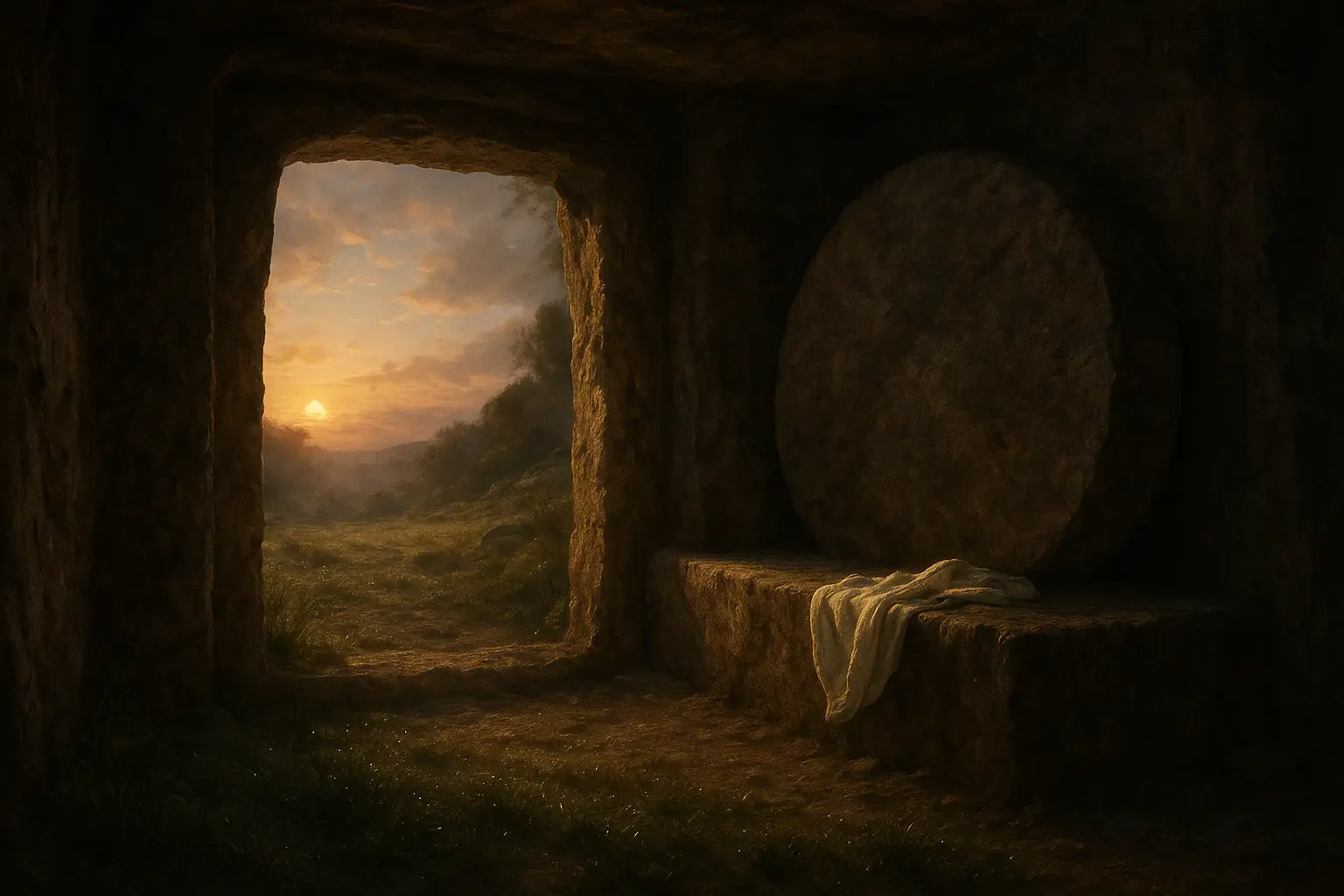
The Buddha died and his relics were divided. Jesus' tomb is empty.
The Buddha never claimed to be God, and his own texts record his death, his last words and the division of his relics into eight portions. Jesus claimed to be the Son of God, died, and rose again, and hundreds saw him alive.
How the Buddha's life ended
The Great Discourse on the Final Extinguishment (Digha Nikaya 16) records the Buddha's last journey, his illness and his death at Kusinara. He told his disciples that after his passing the teaching and training would be their Teacher. His last words were that conditions fall apart, and they should persist with diligence. After the cremation, his relics were divided into eight portions.
The Buddha pointed to a path. He never claimed to be God, to forgive sins, or to rise from the dead.
Then the Buddha addressed Venerable Ānanda: “Now, Ānanda, some of you might think: ‘The teacher’s dispensation has passed. Now we have no Teacher.’ But you should not see it like this. The teaching and training that I have taught and pointed out for you shall be your Teacher after my passing.
Digha Nikaya 16:6.1.1-6.1.5, The Great Discourse on the Buddha’s Extinguishment (tr. Bhikkhu Sujato) · context
Then the Buddha said to the mendicants: “Come now, mendicants, I say to you all: ‘Conditions fall apart. Persist with diligence.’” These were the Realized One’s last words.
Digha Nikaya 16:6.7.1-6.7.4, The Great Discourse on the Buddha’s Extinguishment (tr. Bhikkhu Sujato) · context
“Well then, brahmin, you yourself should fairly divide the Buddha’s relics in eight portions.”
Digha Nikaya 16:6.25.12, The Great Discourse on the Buddha’s Extinguishment (tr. Bhikkhu Sujato) · context
Jesus made claims no teacher makes
Jesus did not point to a way; he said he is the way. He forgave sins, took God's own name, accepted worship, and said he would lay down his life and take it up again. Claims like that are either the most terrible lie or the truth. The resurrection is God's answer.
6Jesus said to him, “I am the way, the truth, and the life. No one comes to the Father, except through me.
John 14:6 (WEB) · context
58Jesus said to them, “Most certainly, I tell you, before Abraham came into existence, I AM.”
John 8:58 (WEB) · context
5Jesus, seeing their faith, said to the paralytic, “Son, your sins are forgiven you.” 6But there were some of the scribes sitting there and reasoning in their hearts, 7“Why does this man speak blasphemies like that? Who can forgive sins but God alone?”
Mark 2:5-7 (WEB) · context
17Therefore the Father loves me, because I lay down my life, that I may take it again. 18No one takes it away from me, but I lay it down by myself. I have power to lay it down, and I have power to take it again. I received this commandment from my Father.”
John 10:17-18 (WEB) · context
28Thomas answered him, “My Lord and my God!” 29Jesus said to him, “Because you have seen me, you have believed. Blessed are those who have not seen and have believed.”
John 20:28-29 (WEB) · context
The evidence for the resurrection
Paul's first letter to the Corinthians, dated by nearly all scholars to the mid-50s AD, passes on an earlier summary he had received: Christ died for our sins, was buried, was raised on the third day, and appeared to Peter, to the Twelve, and to more than five hundred people at once, most of them still alive. The apostles proclaimed it in Jerusalem, the city where he was executed and buried, and many of them suffered for it.
Compare the sources. The New Testament was written within the lifetime of eyewitnesses. The Buddhist discourses were handed down orally and, according to the Sri Lankan chronicles, first written down in the first century BC, some four centuries after the Buddha's death.
3For I delivered to you first of all that which I also received: that Christ died for our sins according to the Scriptures, 4that he was buried, that he was raised on the third day according to the Scriptures, 5and that he appeared to Cephas, then to the twelve. 6Then he appeared to over five hundred brothers at once, most of whom remain until now, but some have also fallen asleep. 7Then he appeared to James, then to all the apostles, 8and last of all, as to the child born at the wrong time, he appeared to me also.
1 Corinthians 15:3-8 (WEB) · context
32This Jesus God raised up, to which we all are witnesses.
Acts 2:32 (WEB) · context
36As they said these things, Jesus himself stood among them, and said to them, “Peace be to you.” 37But they were terrified and filled with fear, and supposed that they had seen a spirit. 38He said to them, “Why are you troubled? Why do doubts arise in your hearts? 39See my hands and my feet, that it is truly me. Touch me and see, for a spirit doesn’t have flesh and bones, as you see that I have.” 40When he had said this, he showed them his hands and his feet. 41While they still didn’t believe for joy, and wondered, he said to them, “Do you have anything here to eat?” 42They gave him a piece of a broiled fish and some honeycomb. 43He took them, and ate in front of them.
Luke 24:36-43 (WEB) · context
Other Buddhist texts
Lotus Sutra (Saddharmapundarika), chapter 16, The Life Span of the Tathagata (Kumarajiva's Chinese, 406 AD) Summary, not a quotation
Teaches that the Buddha attained awakening immeasurable ages ago and only appears to enter nirvana as a skilful means to encourage beings.
What Buddhists answer
Buddhists answer that the Buddha never wanted to be worshipped; he showed the way and left the teaching as guide, and that is a mark of humility. Mahayana sutras such as the Lotus Sutra teach that the Buddha only appeared to pass away, as a skilful means, and is in truth beyond birth and death.
Why that answer falls short
The Buddha's humility in not claiming divinity is real, and honest. But it means his teaching can only be as good as a man's insight. Jesus' claims are bigger, and they were tested publicly: he died under Roman execution and was seen alive. The Lotus Sutra's eternal Buddha appears in a text composed centuries after the Buddha's death, which the early discourses know nothing about.
Where scholars and traditions differ
- The Buddha's dates are uncertain: the traditional Theravada reckoning puts his death in 544/543 BC; many Western scholars place it around 480 BC, and Heinz Bechert and others argue for about 400 BC.
- The Lotus Sutra is generally dated by scholars to between the first century BC and the second century AD.
Sources
- Earliest source Digha Nikaya 16 (Mahaparinibbana Sutta) 6.1, 6.7, 6.10, 6.25. Translation: Bhikkhu Sujato (CC0), SuttaCentral.
- Dipavamsa and Mahavamsa (Sri Lankan chronicles) on the writing down of the canon at Aluvihara in the first century BC.
- Heinz Bechert (ed.), The Dating of the Historical Buddha (Gottingen, 1991-1997).
- Gary Habermas and Michael Licona, The Case for the Resurrection of Jesus (Grand Rapids: Kregel, 2004).